Google Unveils “Project Suncatcher,” a Moonshot to Run AI Workloads on Solar‑Powered Satellite Constellations
Published: 2025-11-06T10:10:30 · Updated: 2026-04-22T08:35:34Z

The proposal hinges on the unique advantages of low‑Earth orbit: a sun‑synchronous dawn‑dusk trajectory would keep the panels bathed in near‑constant sunlight, delivering power levels up to eight times higher than ground‑based installations while slashing the need for heavy batteries. By clustering dozens of compact satellites within a kilometer‑scale formation, Google hopes to achieve inter‑satellite bandwidth in the terabit‑per‑second range, comparable to today’s terrestrial data centers.
To reach those speeds, the team is betting on dense wavelength‑division multiplexing (DWDM) combined with spatial multiplexing. A bench‑scale demonstrator already pushed 800 Gbps in each direction on a single transceiver pair, totaling 1.6 Tbps of bidirectional traffic. Scaling that up will require the satellites to fly in tight formation, a challenge the engineers tackled with a hybrid analytical‑numeric model that refines the classic Hill‑Clohessy‑Wiltshire equations using JAX‑based differentiation. Simulations of an 81‑satellite cluster at 650 km altitude show that nearest‑neighbor distances can be kept to 100–200 m with only modest station‑keeping thrust, thanks to the predictable perturbations of Earth’s non‑spherical gravity field and residual atmospheric drag.
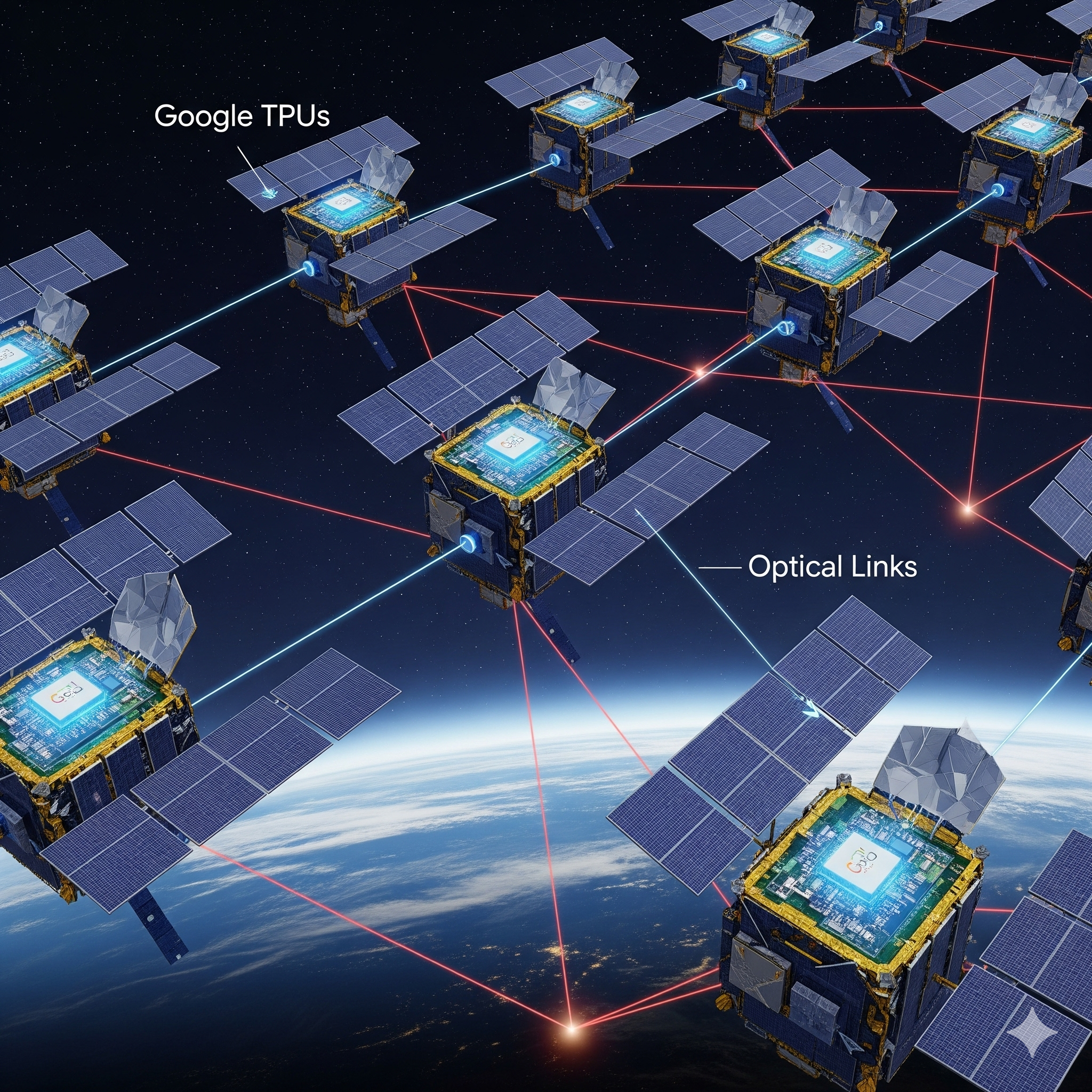
Radiation hardness, another show‑stopper for on‑orbit compute, was put to the test on Google’s v6e “Trillium” Cloud TPU. Exposed to a 67 MeV proton beam, the chips endured a total ionizing dose of 15 krad(Si) without catastrophic failure. The high‑bandwidth memory (HBM) modules began to exhibit errors only after 2 krad(Si), roughly three times the projected shielded dose for a five‑year mission, suggesting that current TPU designs may already be close to space‑ready.
Economic viability, long a barrier to large‑scale orbital infrastructure, appears to be narrowing. The paper cites a learning curve in launch pricing that could push costs below $200 per kilogram by the mid‑2030s. At that rate, the per‑kilowatt‑year expense of a “space‑based data center” would be on par with today’s most energy‑intensive terrestrial facilities, according to publicly reported data‑center energy costs.
Google plans to validate the concept through a partnership with Planet, a provider of Earth‑observation imagery. Two prototype satellites equipped with TPUs and optical interlinks are slated for launch in early 2027. The mission will test distributed machine‑learning workloads in orbit, assess thermal management, and verify the reliability of the optical mesh under real‑world conditions.

If successful, the approach could open a new frontier for AI compute, especially for workloads that demand massive parallelism and can tolerate the latency of space‑based communication. Industry analysts note that the move dovetails with broader trends: the rise of satellite constellations for broadband, the push for greener compute powered by renewable energy, and the relentless demand for AI training capacity that is outpacing terrestrial data‑center growth.
While the roadmap is still in its infancy, Google’s track record of turning moonshots into commercial products—ranging from the early quantum‑computer prototype to the autonomous‑driving platform that became Waymo—adds a dose of credibility to the venture. The next few years will reveal whether the sun, Earth’s most abundant power source, can indeed become the backbone of the next generation of AI infrastructure.
Source: here