Kenya's Capital Markets Authority is cracking down on 15 unauthorized investment platforms actively soliciting public funds
Finance
Published: 2026-09-13T23:49:52 · Updated: 2026-09-13T21:49:52Z
Fintech is the fastest growing category of startups in Kenya. You can literally build an app right now, plug into some crypto or stablecoin APIs and call it a wealth management platform. That does not mean you have the legal right to touch a single shilling of public capital in Kenya.
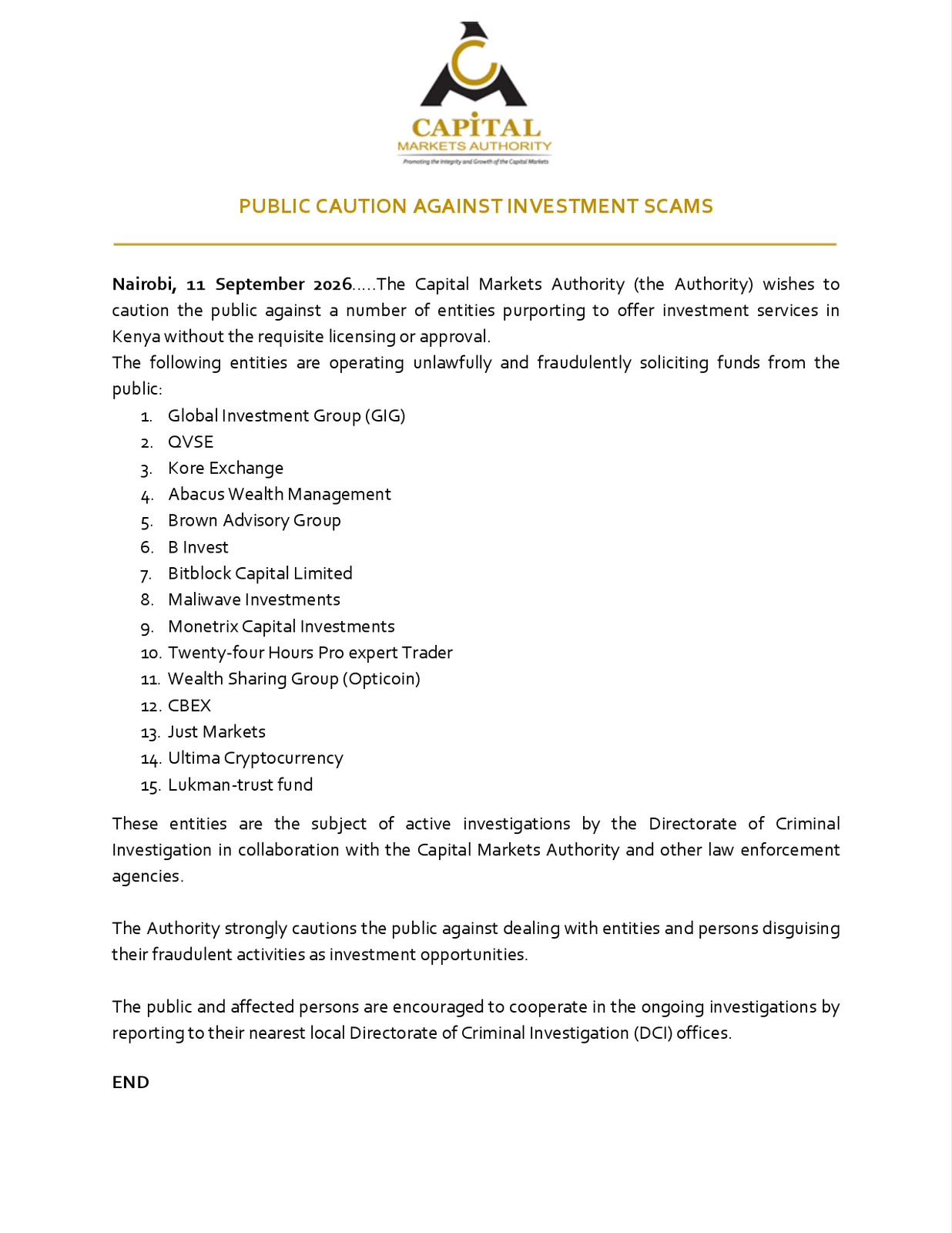
On September 11, CMA (Capital Markets Authority) flagged 15 entities it says are running illegal investment operations. According to the regulator, these outfits are unlawfully and fraudulently soliciting funds. The situation has already escalated with active investigations now underway involving the Directorate of Criminal Investigations and other law enforcement agencies.
The flagged operations include Global Investment Group (GIG), QVSE, Kore Exchange, Abacus Wealth Management, Brown Advisory Group, B Invest, Bitblock Capital, Maliwave Investments, Monetrix Capital Investments, Twenty-four Hours Pro Expert Trader, Wealth Sharing Group (Opticoin), CBEX, Just Markets, Ultima Cryptocurrency, and Lukman-trust fund.
The CMA actually maintains a public register of approved intermediaries so savers can verify who is legally entitled to handle their money. Right now, the regulator is actively asking anyone who has lost funds to these 15 platforms to cooperate with local DCI offices.
This crackdown arrives at a fascinating time. The new regime finally admits that software is eating financial distribution. If you build a fintech app or an aggregator to market securities, you can no longer claim you are just a tech vendor. The CMA created an explicit Intermediary Services Platform category exactly for this. Digital apps are now recognized as formal market players with clear licensing mandates.
Regulators are also paying attention to the code. Algorithms do the heavy lifting of building portfolios today, and the new framework pulls these agents into the oversight net.
The government took a similar approach with over-the-counter trading. Swapping shares directly between parties away from the central exchange is completely normal. Those matching platforms now have a real legal structure to operate within.
Beyond digital channels, the regime modernizes institutional licensing. We now have a unified broker-dealer license alongside dedicated standalone categories for custodians and trustees. Investment banks are also permitted to engage in market-making activities.
Note that this licensing overhaul is distinct from the Capital Markets (Amendment) Act, 2025. That separate statute focuses heavily on equity ownership, shifting the power to prescribe ownership thresholds to the Treasury Cabinet Secretary. It does not introduce specialized fundraising instruments or magically alter venture mechanics for early-stage startups.
Kenya is successfully building precise statutory classifications for software platforms that intermediate investment products. At the exact same time, the CMA is busy chasing unregistered entities that sidestep those classifications entirely. Innovation constantly generates new digital channels to distribute financial assets. Writing new platform licenses into law is definitely a step forward.
Hopefully, regulators will eventually figure out how to spot and shut down these rogue actors before the public actually loses its money.