Safaricom FY26: Mobile Data Just Overtook Voice for the First Time.
Published: 2026-05-08T05:08:04 · Updated: 2026-05-08T03:08:04Z
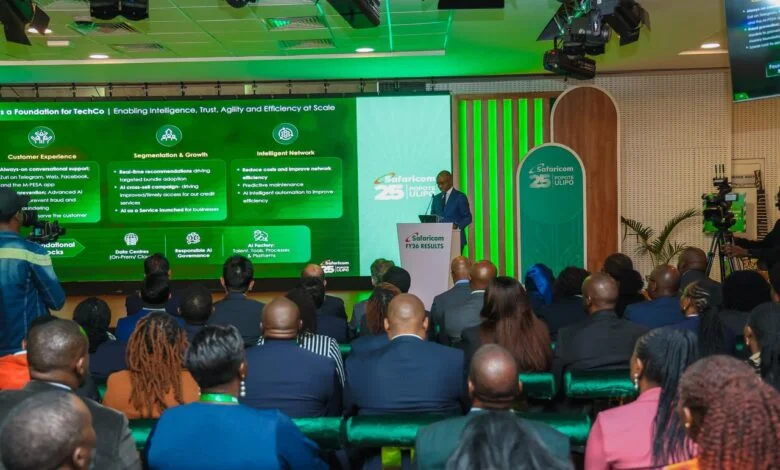
For the first time in Safaricom’s 26-year history, mobile data revenue has surpassed voice. In the financial year ended March 31, 2026, data generated KES 83.4 billion against the KES 81.8 billion brought in by voice. This crossing is more than a commercial milestone; it is a structural signal that the consumption habits reshaping Safaricom’s network for a decade have finally redrawn its income statement.
Connectivity revenue grew 6.9% to KES 197.9 billion. Within that mix, mobile data now accounts for 42.1%, edging past voice at 41.3%. Voice managed a modest 1.3% growth, propped up by a 5.4% increase in minutes of use even as per-minute rates fell 8.5%. Voice is not dying, but it has officially plateaued into a defensive legacy product.
Growth in the Pipes
The 14.4% expansion in mobile data was driven by three converging forces:
- The Device Upgrade Cycle: Smartphones on the network grew 21.2% to 33.2 million. While the 5G base remains modest in absolute terms, active 5G devices surged 55.5% to 1.64 million, signaling a high-value transition among early adopters.
- The Heavy-User Shift: Nearly half the data base—14.5 million customers—now consumes more than 1 GB per month, a 22.4% year-on-year increase. Average monthly usage per subscriber reached 4.92 GB.
- Price Elasticity: The average rate per megabyte fell 12.1% to 5.44 cents. Volume growth successfully outpaced price compression, a classic telecoms trade-off executed with precision.
Meanwhile, messaging continued its structural retreat, falling 11.8% to KES 11 billion. This wholesale migration to over-the-top (OTT) platforms like WhatsApp and Telegram remains a global industry reality that Safaricom is no longer attempting to fight, but rather absorb through data monetization.
Fixed Wireless: The Last-Mile Workaround
While mobile data commands the headlines, the Fixed Service business is becoming a highly efficient growth lever. Revenue rose 12.2% to KES 20.2 billion, with fiber-connected homes reaching 807,000.
The standout metric, however, is 5G Fixed Wireless Access (FWA), which contributed 52.3% of total new fixed connections. This represents a pragmatic shift in infrastructure strategy. Rather than the capital-intensive process of trenching fiber to every premise, Safaricom is leveraging its 5G towers to beam broadband into homes. This "wireless fiber" approach provides a faster, cheaper path to last-mile coverage that sidesteps the heavy per-home capex of traditional rollouts.
The TechCo Identity Crisis
Safaricom’s ambition is to be Africa’s leading technology company by 2030, and the architectural plumbing to support that claim is being assembled.
The September 2025 migration to Fintech 2.0 was a watershed moment. By moving M-PESA to a cloud-native, microservices architecture, Safaricom now handles 6,000 transactions per second (TPS), with headroom for 12,000. This was followed by the November 2025 launch of Daraja 3.0, which opened this infrastructure to over 105,000 developers.
The company’s deep integration into public-sector health, agriculture, and social protection platforms further complicates its categorization. Safaricom is increasingly the digital layer through which the Kenyan government interacts with its citizens.
The Composition Gap
Despite the technological transformation of its backend, Safaricom’s financial reporting remains stubbornly traditional:
- Revenue Concentration: Connectivity (49.4%) and M-PESA (45.6%) still account for 95% of Kenya service revenue. Pure-play tech services remain a rounding error.
- Margin Profile: The Kenya EBITDA margin of 56.8% is world-class for a telco, but it does not yet mirror the 70–80% margins typical of pure software or cloud providers.
- Disclosure Gap: Safaricom does not yet break out software, cloud, or AI-as-a-service as independent line items. The "TechCo" narrative is architectural, but not yet legible in the earnings breakdown.
Net income for Kenya jumped 24.7% to KES 119.1 billion, a formidable result. At the Group level, service revenue grew 11.5% to KES 414.1 billion, supported by an accelerating Ethiopia operation that contributed 12.5% of Group growth despite an expected EBIT loss of KES 37.7 billion during its investment phase.
A Utility with Ambition
Safaricom is a high-performance utility with serious technology capabilities; not yet a technology company in the software-centric sense. Real tech companies derive value from licensing, intellectual property, and high-margin subscriptions. Safaricom still derives its value from usage: minutes, megabytes, and transaction percentages.