The Ocean Is the Next Data Center
Published: 2026-05-23T13:02:59 · Updated: 2026-05-28T15:24:51Z
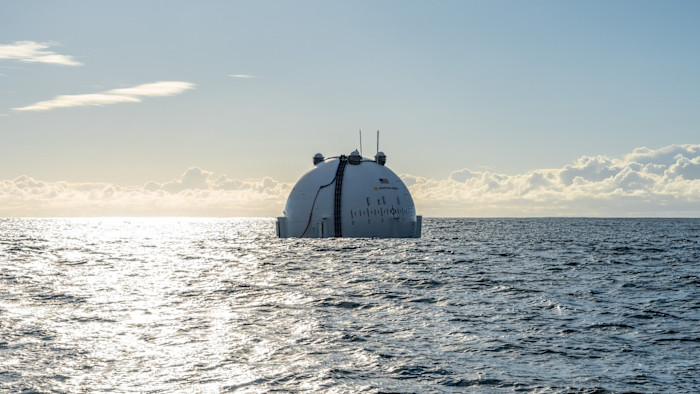
The nodes themselves are large steel-shell structures, roughly 85 meters long, that sit mostly underwater. AI accelerator racks run inside a sealed internal environment while the surrounding seawater provides free, passive cooling. The power comes from the ocean itself. Each node generates clean, around-the-clock electricity from ocean waves, features autonomous propulsion and navigation, and transmits inference-related data to shore via satellite links rather than traditional grid connections. The company has been building toward this for a decade, validating the core systems through three generations of prototypes tested in 2021 and 2024.
Rather than novelty, the reason this is attracting serious capital is that the three problems Panthalassa solves are exactly the three problems currently strangling AI expansion on land. Power is the first. Building new terrestrial energy capacity to feed data centers takes years, which is time the AI industry does not have. Cooling is the second. Land-based data centers spend enormous resources running chillers to keep chips alive. The ocean eliminates that cost entirely. Land use is the third. Nodes sit far offshore, avoiding zoning battles, local resistance, and the need to trench fiber or power lines through dense urban areas. Ocean infrastructure does not need a planning commission.
 The $140 million will be used to finish a pilot manufacturing facility near Portland designed to mass-produce nodes from plate steel, and to deploy the Ocean-3 node series in the northern Pacific in 2026 to demonstrate AI inference capabilities at sea. Co-founder Stuart Sheldon-Coulson has indicated the goal is to have at-sea units operating permanently by around August 2026, with commercial deployments following in 2027. The engineering team behind this includes veterans from SpaceX, Tesla, and NASA, which reflects the operational complexity of running AI chips reliably in a harsh, remote, permanently wet environment. This is not a cloud company. It is closer to a maritime engineering firm that happens to run inference workloads.
The second-order question, the one that matters most for ecosystems further down the infrastructure chain, is who gets access to this compute and on what terms. If ocean-based AI nodes become commercially viable at scale, they could meaningfully alter the power dynamics of who controls the next layer of AI infrastructure. Right now, AWS, Google Cloud, and Azure serve most of the world's AI compute needs from facilities concentrated in the United States and Europe. AI-driven inference for ocean monitoring, climate modeling, maritime logistics, or coastal-country AI services could be run closer to the edge rather than routed back to distant hyperscalers. That is a structural shift, not just a technical one.
Africa's cloud dependency runs almost entirely through European hyperscaler infrastructure. When those facilities face grid stress, the pressure travels downstream. A viable ocean compute layer changes the geography of where AI infrastructure can exist, and potentially who can build it. Kenya has geothermal resources and a coastline. The idea that sovereign or regional AI infrastructure could eventually be powered by ocean energy is not science fiction. It is the logical extension of exactly what Panthalassa is testing right now in the Pacific. Whether that potential gets realized here depends entirely on whether African governments and investors are watching closely enough to move when the window opens.